
Research paper
TradingAgents: Multi-Agent LLM Financial Trading Framework
TradingAgents is the open-source multi-agent LLM framework that inspired this hosted desk. The paper, by Yijia Xiao, Edward Sun, Di Luo, and Wei Wang, models a trading firm: specialist analysts, bull and bear researchers, a trader, risk voices, and a fund manager. This page explains that architecture. It does not claim the authors’ backtest as TradingAgents Report performance.
- Identifier
- arXiv:2412.20138
- Authors
- Xiao, Sun, Luo, Wang
- Version
- v7 · 3 Jun 2025
What the TradingAgents paper is
TradingAgents is a multi-agent LLM financial trading framework that assigns specialized roles the way a research desk does. Analysts collect dated evidence. Bull and Bear researchers debate. A trader proposes an action. A risk team stress-tests it. A fund manager approves. The paper reports a historical simulation on AAPL, GOOGL, and AMZN. Those figures belong to the authors’ experiment, not to this hosted product.
How the framework is organized
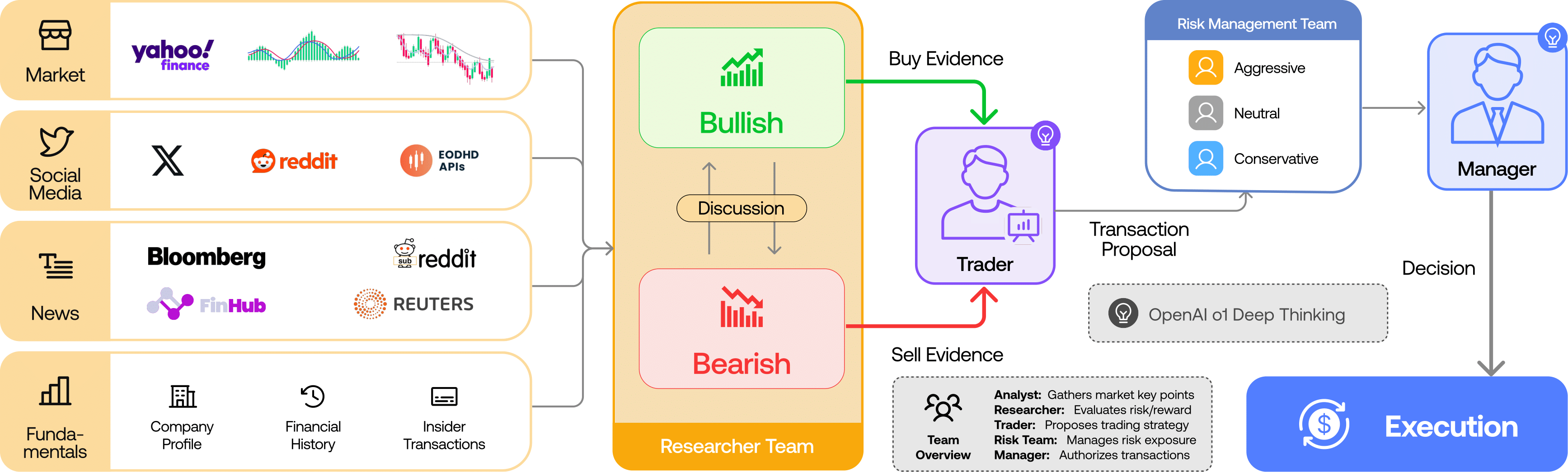
Figure 1 in the paper, and the matching diagram in the public repository, show five stages: analyst team, research debate, trader, risk management, and fund-manager approval. Data enters as market, social, news, and fundamental evidence. Decisions leave as a documented plan, not as a hidden score.
Seven roles, one inspectable firm
The paper assigns seven named roles. Each role has a goal, constraints, and tools. Together they break a trading question into evidence, disagreement, a proposed action, and a risk-adjusted decision.
Analyst team
Four specialists run in parallel. The fundamental analyst reads filings and quality. The sentiment analyst reads social and public mood. The news analyst reads company and macro events. The technical analyst reads price, volume, and indicators such as MACD and RSI. Their reports become the shared evidence pack.

Researcher team
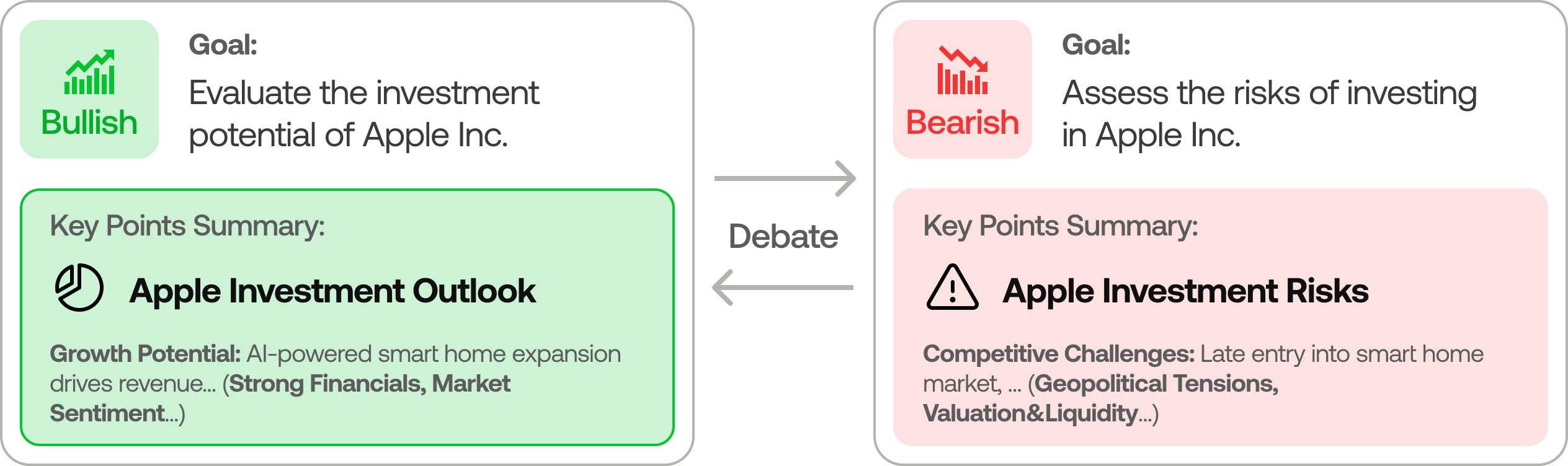
A bullish researcher argues for opportunity. A bearish researcher argues for risk. They debate for a configured number of rounds. A facilitator records the prevailing view as structured state, so later roles can query the debate instead of rereading a long chat.
Trader agent
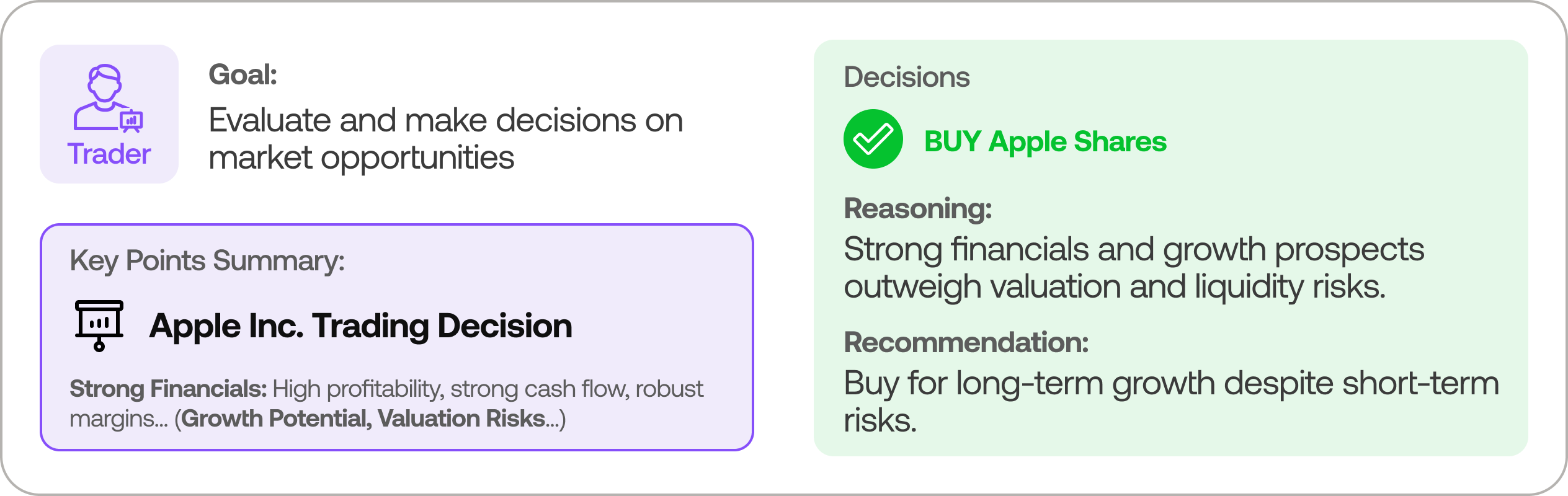
The trader reads analyst reports and the debate record, then writes a decision with rationale: timing, size, and buy, sell, or hold. In the paper this is a simulated order proposal. On TradingAgents Report it is an intermediate plan, not the public five-tier rating.
Risk team and fund manager
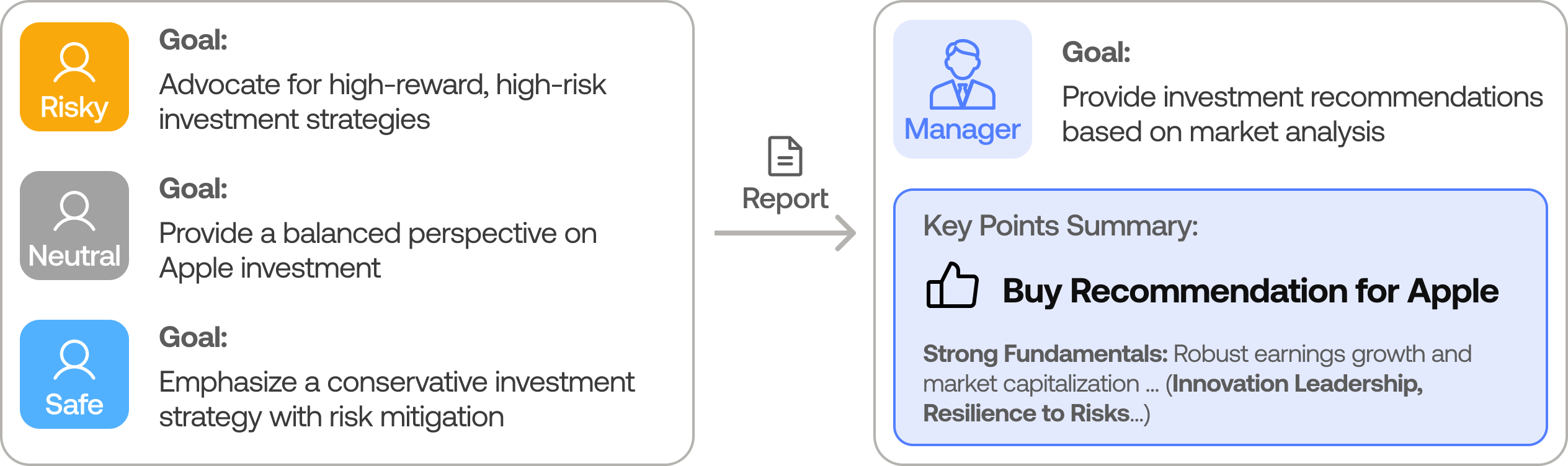
Aggressive, conservative, and neutral risk voices review the trader’s plan against volatility, liquidity, and stated limits. The fund manager then accepts, rejects, or adjusts the proposal. The paper’s “execution” step is a simulated exchange. This product does not route live broker orders.
Structured reports, then debate
The paper’s communication protocol is built to stop a telephone-game of long chat logs. Most roles write structured reports into a shared state. Natural language is reserved for the debates that need it.
Structured reports
Analysts and the trader write concise documents: metrics, claims, and a recommendation. Later agents query that state instead of scanning an unbounded message history.
Natural-language debate
Researchers and the risk team still talk. A facilitator keeps the round count finite and writes the outcome back as structured state.
Quick-think and deep-think models
The paper pairs faster models with retrieval and summarization, and deeper models with analysis and decisions. The hosted desk uses an admin-controlled catalog; a model named in the paper is not automatically enabled here.
What the paper reported
Xiao et al. simulate daily decisions from 19 June 2024 to 19 November 2024 on AAPL, GOOGL, and AMZN, using only information available on each day. They compare TradingAgents with buy-and-hold and rule strategies (MACD, KDJ & RSI, ZMR, SMA). The numbers below are copied from Table 1 of arXiv:2412.20138v7. They are not live results, not this product’s track record, and not a promise of future return.
- Simulation window
- 19 Jun 2024 – 19 Nov 2024
- Sample dataset window
- 1 Jan 2024 – 29 Mar 2024
- Reported names
- AAPL · GOOGL · AMZN
| Model | AAPL CR% | AAPL ARR% | AAPL SR | AAPL MDD% | GOOGL CR% | GOOGL ARR% | GOOGL SR | GOOGL MDD% | AMZN CR% | AMZN ARR% | AMZN SR | AMZN MDD% |
|---|---|---|---|---|---|---|---|---|---|---|---|---|
| B&H | -5.23 | -5.09 | -1.29 | 11.90 | 7.78 | 8.09 | 1.35 | 13.04 | 17.1 | 17.6 | 3.53 | 3.80 |
| MACD | -1.49 | -1.48 | -0.81 | 4.53 | 6.20 | 6.26 | 2.31 | 1.22 | — | — | — | — |
| KDJ&RSI | 2.05 | 2.07 | 1.64 | 1.09 | 0.4 | 0.4 | 0.02 | 1.58 | -0.77 | -0.76 | -2.25 | 1.08 |
| ZMR | 0.57 | 0.57 | 0.17 | 0.86 | -0.58 | 0.58 | 2.12 | 2.34 | -0.77 | -0.77 | -2.45 | 0.82 |
| SMA | -3.2 | -2.97 | -1.72 | 3.67 | 6.23 | 6.43 | 2.12 | 2.34 | 11.01 | 11.6 | 2.22 | 3.97 |
| TradingAgents (paper) | 26.62 | 30.5 | 8.21 | 0.91 | 24.36 | 27.58 | 6.39 | 1.69 | 23.21 | 24.90 | 5.60 | 2.11 |
Table 1 from Xiao et al., TradingAgents (arXiv:2412.20138v7). CR is cumulative return, ARR is annualized return, SR is Sharpe ratio, MDD is maximum drawdown. MACD results for AMZN were not reported.
How this hosted desk relates
TradingAgents Report reuses the inspectable research graph: optional evidence modules, bull/bear debate, trader plan, risk review, and a Portfolio Manager rating. It adds billing, private jobs, exchange allowlists, and curated public reports. It does not treat the paper’s simulated fills as a product feature.
What carries over
Specialist evidence, an explicit analysis date, opposing research, and a written risk review remain the core of a report you can audit.
What is different here
Public pages show a five-tier Portfolio Manager rating, not a live order. Simulated Trading is a separate virtual ledger you submit yourself. Upstream experiments are not automatically enabled.
Cite the paper
If the framework helps your work, cite the authors’ arXiv preprint. This explainer is a product page, not a substitute for the PDF.
Yijia Xiao, Edward Sun, Di Luo, and Wei Wang
University of California, Los Angeles; Massachusetts Institute of Technology
arXiv preprint arXiv:2412.20138 (q-fin.TR), first posted 28 December 2024; this page follows v7, 3 June 2025.
@article{xiao2024tradingagents,
  title={TradingAgents: Multi-Agents LLM Financial Trading Framework},
  author={Xiao, Yijia and Sun, Edward and Luo, Di and Wang, Wei},
  journal={arXiv preprint arXiv:2412.20138},
  year={2024}
}
Framework figures are copied from the Apache-2.0 TradingAgents repository. Read the paper and the repository license before reuse.
Paper FAQ
Common questions about the TradingAgents paper
What is the TradingAgents paper?
It is an arXiv preprint (2412.20138) that describes a multi-agent LLM financial trading framework. Specialized analysts, bull and bear researchers, a trader, a risk team, and a fund manager collaborate through structured reports and debate.
Is TradingAgents Report the same as the paper?
No. The paper and GitHub project are the upstream research framework. TradingAgents Report is a hosted research desk with billing, private jobs, and published reports. Deployed roles and models can differ from the paper’s experiment.
Where is the open-source code?
The authors publish TradingAgents at github.com/TauricResearch/TradingAgents under Apache License 2.0. This product’s self-hosted engine is the Apache 2.0 derivative at github.com/tradingagents-report/tradingagents-report. The open-source page separates those repositories from the hosted desk.
Do the paper’s returns apply to this product?
No. Table 1 is the authors’ historical simulation on three US names in 2024. It is not a live track record, not this product’s performance, and not investment advice.
Does the framework place live trades?
The paper’s execution step is a simulated exchange for research. TradingAgents Report generates research reports and optional simulated-ledger practice. It does not connect to a broker or place live orders.
How should I cite TradingAgents?
Cite Xiao, Sun, Luo, and Wang, “TradingAgents: Multi-Agents LLM Financial Trading Framework,” arXiv:2412.20138. Use the BibTeX on this page or the official arXiv record.
Continue from the paper
Use the method page for the hosted graph, the open-source page for the repository, and public reports to see a finished research artifact.