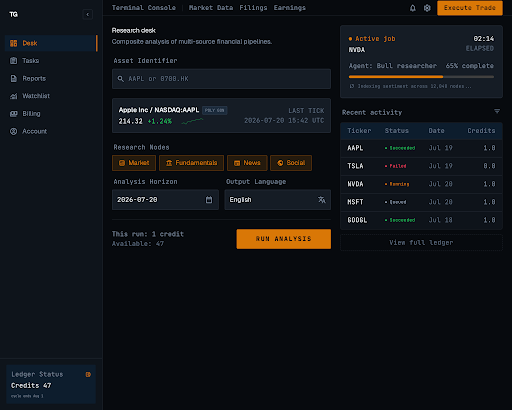
TradingAgents Report research desk showing a multi-agent stock analysis workflow

12research roles

TradingAgents Report

TradingAgents Report is a multi-agent research desk that turns one listing into evidence, debate, risk review, and a five-tier final rating. Research only. No trade execution.

New accounts receive free analysis credits

12
research roles

Evidence modules, Bull/Bear debate, planning, risk review, and the Portfolio Manager form a traceable research path.

5-tier
final rating scale

The Portfolio Manager issues the product conclusion: Buy, Overweight, Hold, Underweight, or Sell.

Multi-market
enabled exchanges

US, Hong Kong, China A-shares, Japan, and Taiwan, subject to the deployment whitelist.

Research only
no broker access

Reports and structured decision briefs only. No fund management, brokerage connection, or order placement.

How research forms

Evidence, debate, then a final rating

Optional specialist modules gather evidence. Bull and Bear debate, a Research Manager plan, Trader proposal, and risk review always follow. The Portfolio Manager issues the final five-tier rating.

Read the full research method
  1. Specialist evidence

    01

    Choose Market, Sentiment, News, and Fundamentals modules. Selected analysts run in a fixed order from the confirmed listing and analysis date.

  2. Debate and research plan

    02

    Bull and Bear researchers challenge the evidence. The Research Manager drafts an investment plan; the Trader proposes Buy, Hold, or Sell as an intermediate step, not the final product rating.

  3. Risk review and final rating

    03

    Aggressive, Conservative, and Neutral risk voices stress-test the plan. The Portfolio Manager decides Buy, Overweight, Hold, Underweight, or Sell.

    • Market
    • Sentiment
    • News
    • Fundamentals
    • Bull / Bear
    • Research Manager
    • Trader
    • Risk review
    • Portfolio Manager

What you receive

Decision brief and role reports

Read the Portfolio Manager decision first, then the Markdown from roles that ran.

  • Five-tier final rating

    The Portfolio Manager issues Buy, Overweight, Hold, Underweight, or Sell.

  • Structured decision card

    Conviction, reference price, position, zones, target, and key risks.

  • Analyst signal lanes

    Market, sentiment, news, and fundamentals signals appear only when their modules ran.

  • Full role Markdown

    Full specialist, debate, risk, and manager reports, exportable from the product app.

Browse published reports

Markets and data

Coverage stated with its limits

Research runs only on admin-enabled exchanges after listing identity is resolved. Every report records an analysis date; quotes can be delayed.

NASDAQUS tech & growth
NYSEUS blue chips
AMEXUS ETFs & small caps
OTCUS OTC market
HKEXHong Kong listings
SSEShanghai A-shares
SZSEShenzhen A-shares
TSEJapan listings
TWSETaiwan main board
TPEXTaiwan OTC market
  • Enabled exchange set

    Default seeds include US (NASDAQ, NYSE, AMEX, OTC), HKEX, China A-shares (SSE, SZSE), Japan (TSE), and Taiwan (TWSE, TPEX). Live availability follows the deployment whitelist.

  • Listing identity first

    Ticker, exchange, and asset identity are resolved before research. Provider-specific symbols are not the public instrument identity.

  • Time-bounded evidence

    Prices, fundamentals, and news stay inside the selected analysis date. Missing source fields are not invented; social or prediction inputs may reflect live-at-run data.

See markets and data boundaries

Research desk

Run the pipeline in the product app

Sign in to search a listing, set the analysis date, choose evidence modules and models, then track the job through to a report.

01

Listing-aware input

Search by symbol, confirm the exchange, and keep ticker identity separate from vendor-only codes.

02

Configurable evidence modules

Market, fundamentals, news, and sentiment are optional. Debate, risk review, and the Portfolio Manager always run.

03

Batch up to five symbols

Submit up to five instruments at once. Each creates its own analysis job and credit check.

04

Quick and deep models

Pick quick-think and deep-think models from the admin-open catalog. Both stay on the same provider for one job.

05

Usage-point billing

Plan points and bonus points are tracked separately. Successful or user-cancelled runs settle from actual AI cost; system failures are not charged.

New accounts receive free analysis credits

Start free research

Open source and origins

Framework roots, product boundaries

TradingAgents is the upstream open-source research framework. TradingAgents Report is the hosted desk, billing, and curated public-report experience built on that workflow.

Upstream framework

Inspect the multi-agent graph, data routing, issue history, and contribution path on the public repository.

Read the TradingAgents paper for the original research context behind specialist analysis and debate.

Hosted product scope

Subscriptions, private jobs, and admin-published reports live here. Upstream experiments are not automatically enabled in this deployment.

Explore open-source origins

Usage capacity

Usage points for research capacity

Monthly plans grant cycle usage points for the research desk. New accounts can also start with signup bonus points. Live prices and entitlements are confirmed in the product billing page.

Starter 20

Entry cycle capacity for individual research workflows.

$20/ month

2,000 usage points / cycle

  • 2,000 plan points each billing cycle
  • Research desk on enabled exchanges
  • Cost-based settlement per finished job
Select Starter 20

Scale 100

Expanded capacity for broader watchlists and small teams.

$100/ month

10,000 usage points / cycle

  • 10,000 plan points each billing cycle
  • Research desk on enabled exchanges
  • Cost-based settlement per finished job
Select Scale 100

Max 200

Highest published monthly capacity on the public catalog.

$200/ month

20,000 usage points / cycle

  • 20,000 plan points each billing cycle
  • Research desk on enabled exchanges
  • Cost-based settlement per finished job
Select Max 200

Marketing catalog only. Points are not one report per point: finished jobs settle from actual AI cost with the active markup. Checkout always uses the live catalog in the product app.

Clarity first

Frequently asked questions

What is TradingAgents Report?

TradingAgents Report is a hosted multi-agent equity research desk built on the TradingAgents framework. Optional Market, Sentiment, News, and Fundamentals modules gather evidence; Bull/Bear debate, Research Manager, Trader, risk review, and Portfolio Manager always run to produce a traceable report and five-tier final rating. It does not execute trades.

Does TradingAgents Report execute trades?

No. The product produces research reports and structured decision briefs only. It does not connect to a brokerage, manage funds, or place orders.

Is every report based on live data?

Each report records an explicit analysis date. Historical prices, fundamentals, and news are bounded to that date. Quotes disclose source and time and may be delayed. Some sentiment or prediction-market inputs can reflect live-at-run data rather than a historical as-of snapshot.

Why can reports differ across models or runs?

LLM behavior, temperature, data availability, and nondeterminism all affect output. The agent graph keeps roles and evidence flow consistent so you can compare process quality across providers such as OpenAI, Anthropic, Google Gemini, and DeepSeek when those models are enabled in the catalog.

How are usage points charged?

Plan points refresh each billing cycle; bonus points from signup, referral, or admin grants can carry over. Available balance must be above the analysis threshold to start. Finished jobs settle from actual AI USD cost times the configured points-per-USD and markup. System failures are not charged; user cancel can still settle actual cost. Checkout always uses the live catalog in the product app.

Can I use a report as investment advice?

No. Reports are informational research references, not personalized investment advice. Verify important evidence independently and decide within your own risk framework.